When academia meets the hospital.
2026
What a master’s thesis in computational simulation teaches us about emergency management.
The silent problem of hospital management.
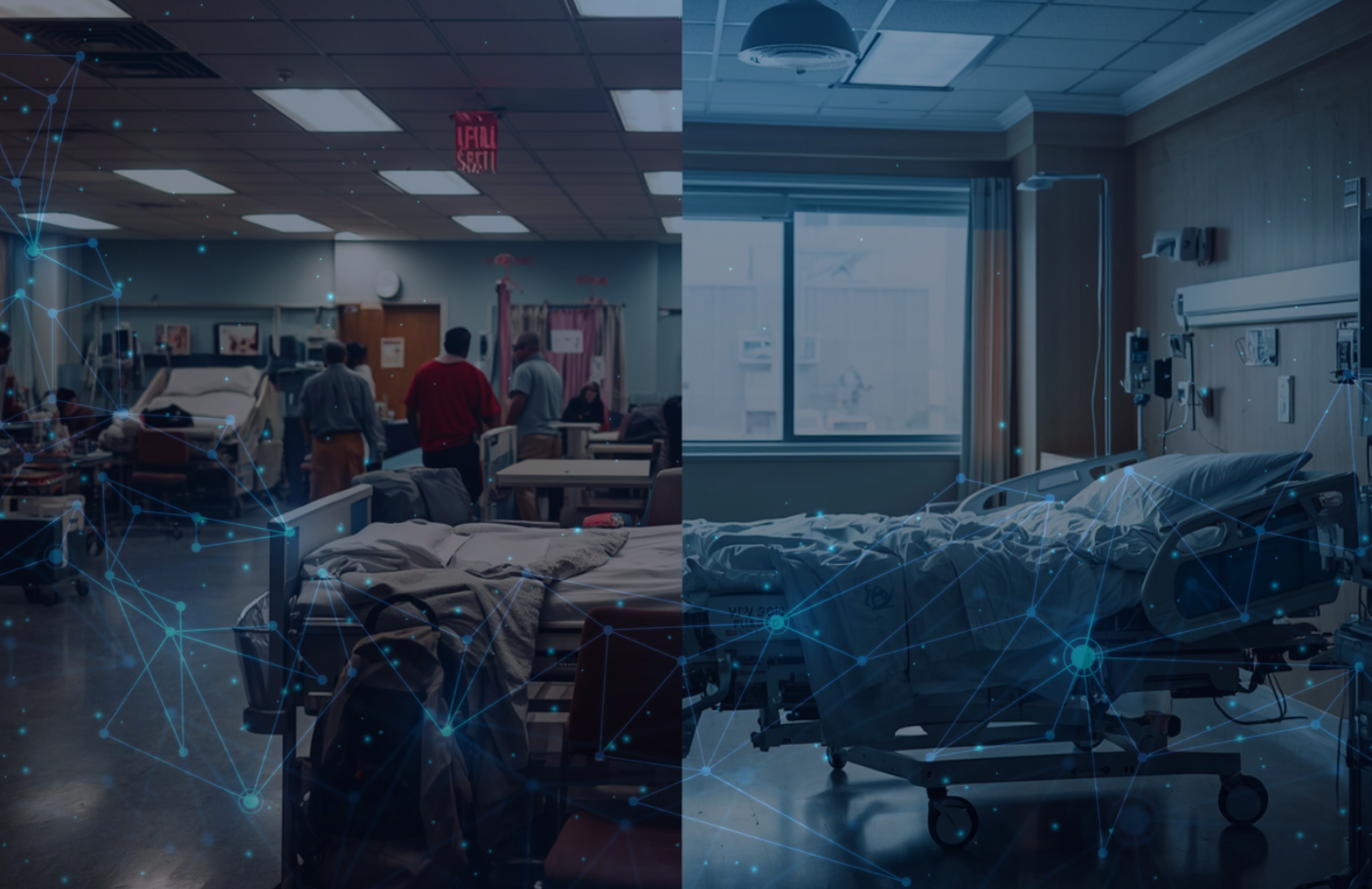
Between 2013 and 2023, Portugal had an average of 70 emergency room visits per 100 inhabitants, more than double the OECD average. And 42% of these visits were, according to the National Health Service itself, non-urgent cases. Cases that could have been resolved within the scope of Primary Health Care.
The numbers don’t help. A visit to the emergency room costs the National Health Service (SNS) around €85.91. A consultation in primary care costs between €21.63 and €38.04 per hour. Each patient referred to the right place saves the taxpayer up to €80. Not to mention the doctor’s time that is freed up for truly urgent cases.
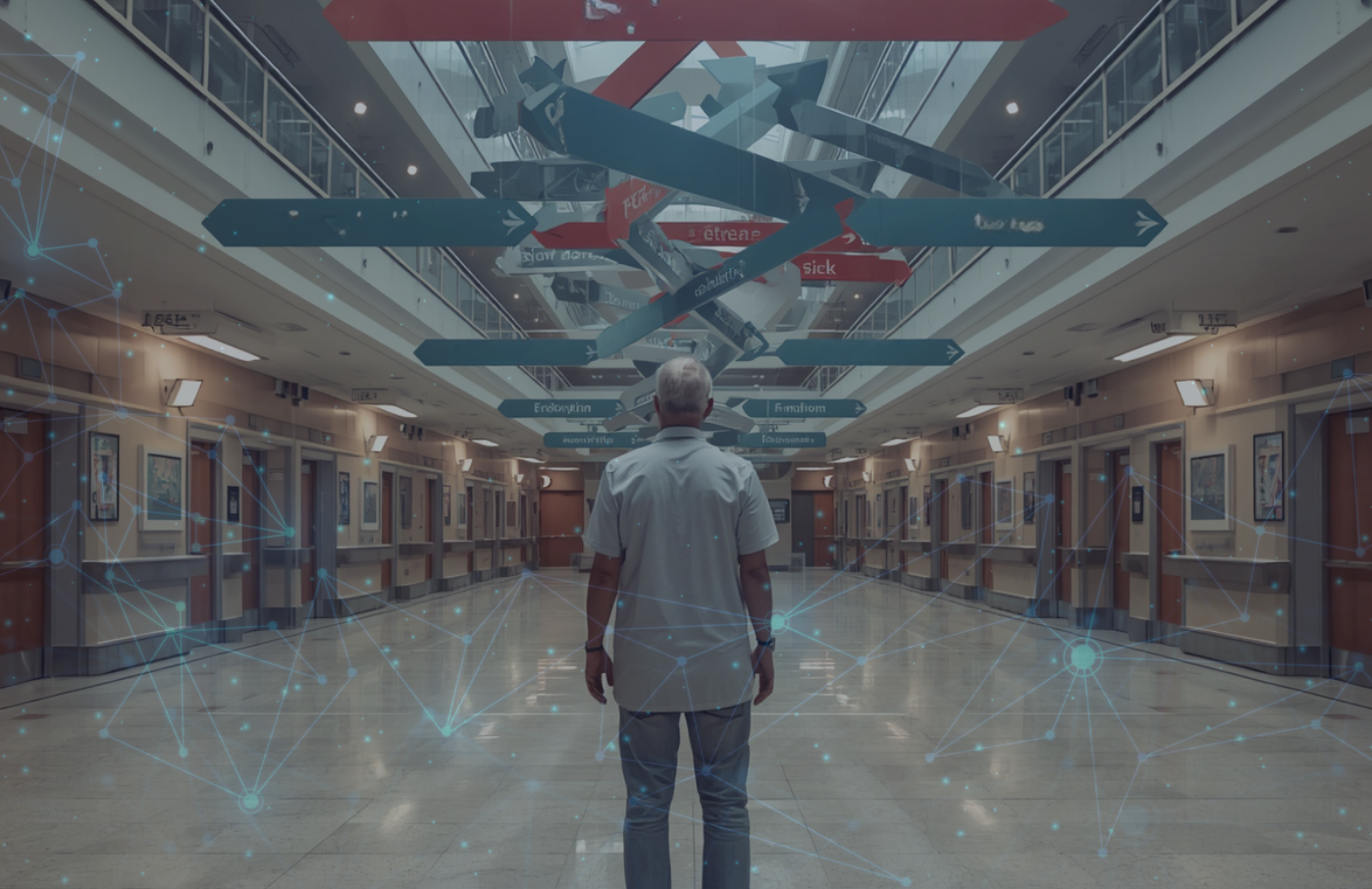
We continue to treat this as if it were a resource problem. What if it is, first and foremost, a flow problem?
Simulate before making changes.
In industry, no one opens an assembly line without simulating it. In aviation, no one puts a pilot to fly without thousands of hours in a simulator. In healthcare, the norm is still to test directly in the field, with real patients serving as unwitting guinea pigs.
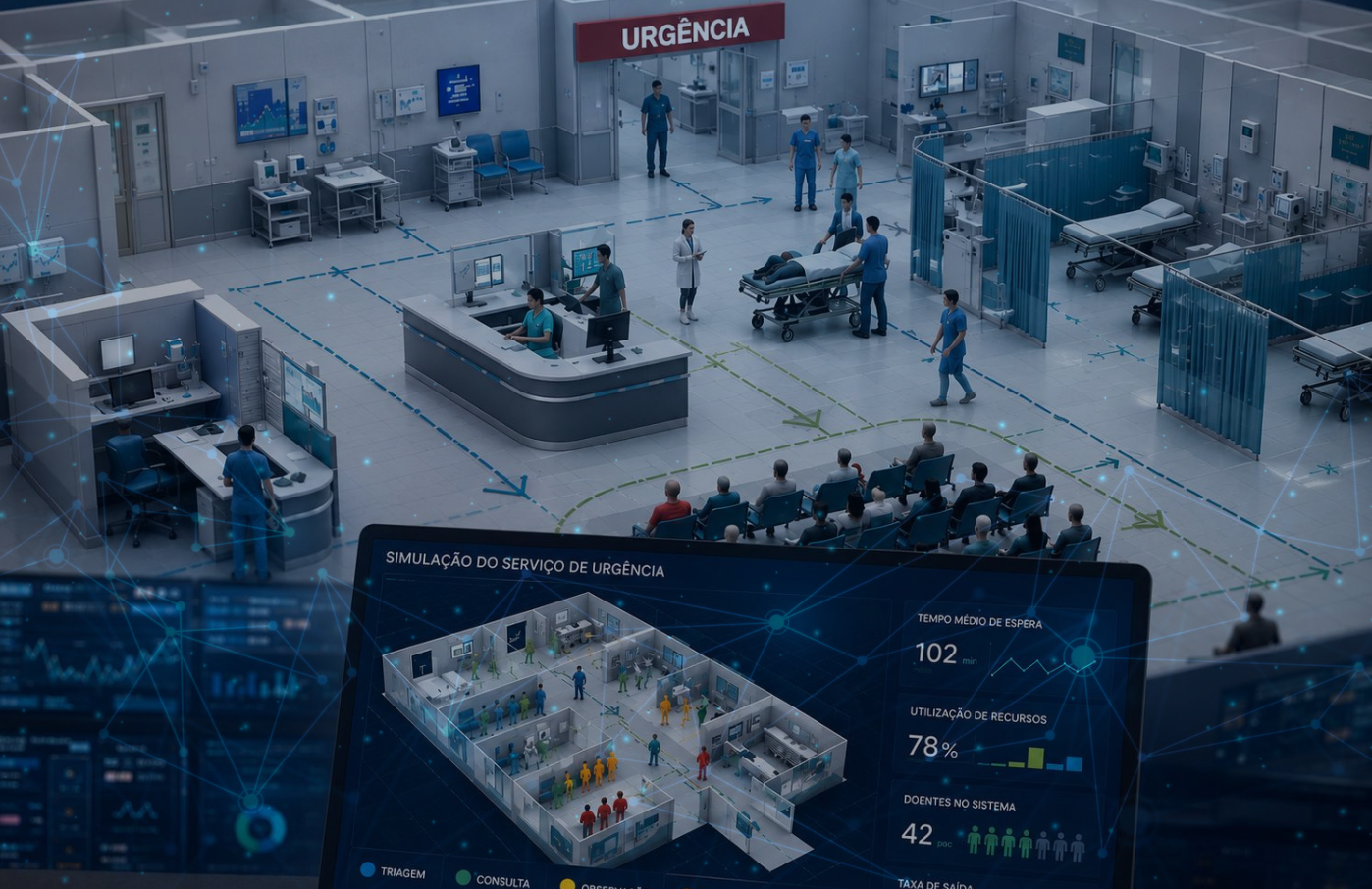
Discrete Event Simulation (DES) does what no manager can do otherwise: it recreates the real flow of an emergency room on a computer, with all its natural chaos (peak influx, shifts, examination times), and allows testing dozens of scenarios without touching the live system. In a PRISMA review of 29 studies published between 2014 and 2025, DES appears in 75% of the works on improving emergency room services.
The study: 53,879 episodes, four scenarios
The master’s thesis in Industrial Engineering and Management, recently defended by Maria Sofia Sarradell Felizes at the Instituto Superior Técnico, in partnership with Lean Health Portugal , constructed a model of patient flow in the General Emergency Department of a National Health Service (SNS) hospital. It was calibrated with 53,879 real episodes from 2024 and validated with errors below 2.5%.
Then he tested four scenarios:
- Co-located Primary Health Care (PHC) Unit, in two versions: daytime only and 24-hour.
- Fast-Track internal care for Green patients, 24/7, with a dedicated doctor via telemedicine.
- Hybrid: UCSP + Fast-Track.
- Fast-Track seasonal service, only for non-urgent respiratory patients in winter.
Three results that challenge preconceived notions.
The bottleneck isn’t where it was thought to be. The Non-Ambulatory and Minor Surgery pathways at HBA are functioning regularly. The ambulatory pathway, however, is overwhelmed, with medical utilization exceeding 100%. For the ambulatory pathway, the average waiting times were 7.3 hours for Yellow patients, 10.6 hours for Green patients, and 12.4 hours for Blue patients. This isn’t a generalized shortage of doctors. It’s a mismatch between the type of demand received and the type of response the hospital is designed to provide.
Not all solutions carry the same weight. The primary care clinic only provides relief while it’s open. When it closes, the demand returns. The 24-hour primary care clinic reduces waiting times for Green (patient) patients by 58.9% and abandonment rates by 94.2% . The Fast-Track telemedicine system goes even further: it cuts waiting times by 79.5% and practically eliminates abandonment rates ( 99.4% ), with a single dedicated doctor, without diverting staff from acute emergencies.
Putting more doctors on 24-hour duty seems like a good idea, but it’s not the best. It produces greater improvements at first glance, but the new capacity is swallowed up by the existing demand on the waiting list. The overload returns. Redirecting the demand, instead of chasing it with more supply, solves the structural problem. And it costs much less. Not taking advantage of these results is wasting knowledge already produced and validated, delaying a change that could be quick and structural.
Wasted potential
A thesis like this represents six to twelve months of work by a highly qualified engineer, under the guidance of professors who have spent decades in operational research. For the hospital, the marginal cost is zero. For the university, it is the cost of training a student who would have graduated anyway.
Despite this, most Portuguese hospitals have never collaborated on a thesis like this. When they do collaborate, it’s almost always because a clinician or administrator has a personal contact at the university. There’s no institutional channel, no list of open problems, nor a process to take the results and put them into practice.
This results in two wastes at the same time. In universities, very good theses are written on synthetic data or on foreign cases, because Portuguese data is difficult to obtain. In hospitals, decisions costing hundreds of thousands of euros are based on intuition or on reports from consulting firms at market price, when there was a top-notch analytical resource available for free 20 minutes away.
This thesis is exceptional because it brought together three things rarely found together in Portugal: a university open to practical application (IST), an organization that acted as a bridge ( Lean Health Portugal ), and a local health unit with the courage to open its data to academia (ULS Loures / HBA). This should be the norm.
What to do from here
Three concrete ideas, directly derived from this work:
- Redesign the front line instead of reinforcing the back line. External emergency circuits truly functioning alongside emergency services, coordinated with the SNS24 helpline.
- Simulate before reforming. Any structural change with significant cost deserves a model that anticipates its impact. Making mistakes on a computer won’t kill anyone and won’t cost money.
- To give institutional status to university-hospital partnerships. Each Local Health Unit (ULS) could publish its list of open operational problems, cross-referenced with the competencies of the universities in its region. The model already exists (Netherlands, United Kingdom, Canada), consolidated international examples that can be directly replicated in our reality.
In Portugal, we have the knowledge and the people to solve a large part of the operational problems of the National Health Service. What we lack is a systematic approach to connecting researchers with decision-makers.
Thesis work: Maria Sofia Sarradell Felizes, “Evaluating Emergency Department Improvement Scenarios in the Portuguese NHS Using Discrete-Event Simulation”, Instituto Superior Técnico, March 2026. Supervision: Prof. Daniel Rebelo dos Santos (IST) and Rui Neves Cortes (Lean Health Portugal). Collaboration with Hospital Beatriz Ângelo / ULS Loures.