
Operations management in healthcare remains undervalued
2026
Healthcare demands evidence for everything. To prescribe medication. To validate a surgical procedure. To alter a clinical protocol. Nothing progresses without data, without trials, without proof.
Therefore, the question arises: how many of the processes that underpin all these clinical practices have been formally designed, tested, or measured?
This is the contradiction that the sector avoids naming: we have made medicine extraordinarily rigorous, but is this rigor matched at the process level?
This is not a criticism of the people, it’s a criticism of the lack of processes!
This operational problem is what we frequently see in Lean Health Portugal projects — high clinical rigor supported by fragile processes that have never been formally designed, tested, or measured. By addressing clinical and administrative workflows , we reduce waiting times and waste without ‘adding more resources’, but by designing processes with continuous flow.
Innovation in healthcare: why operations management continues to be overlooked.
When we talk about modernization in healthcare, we think of surgical robotics, artificial intelligence-powered diagnostics, precision medicine. Perhaps an evolution never before seen, in such a rapid way.
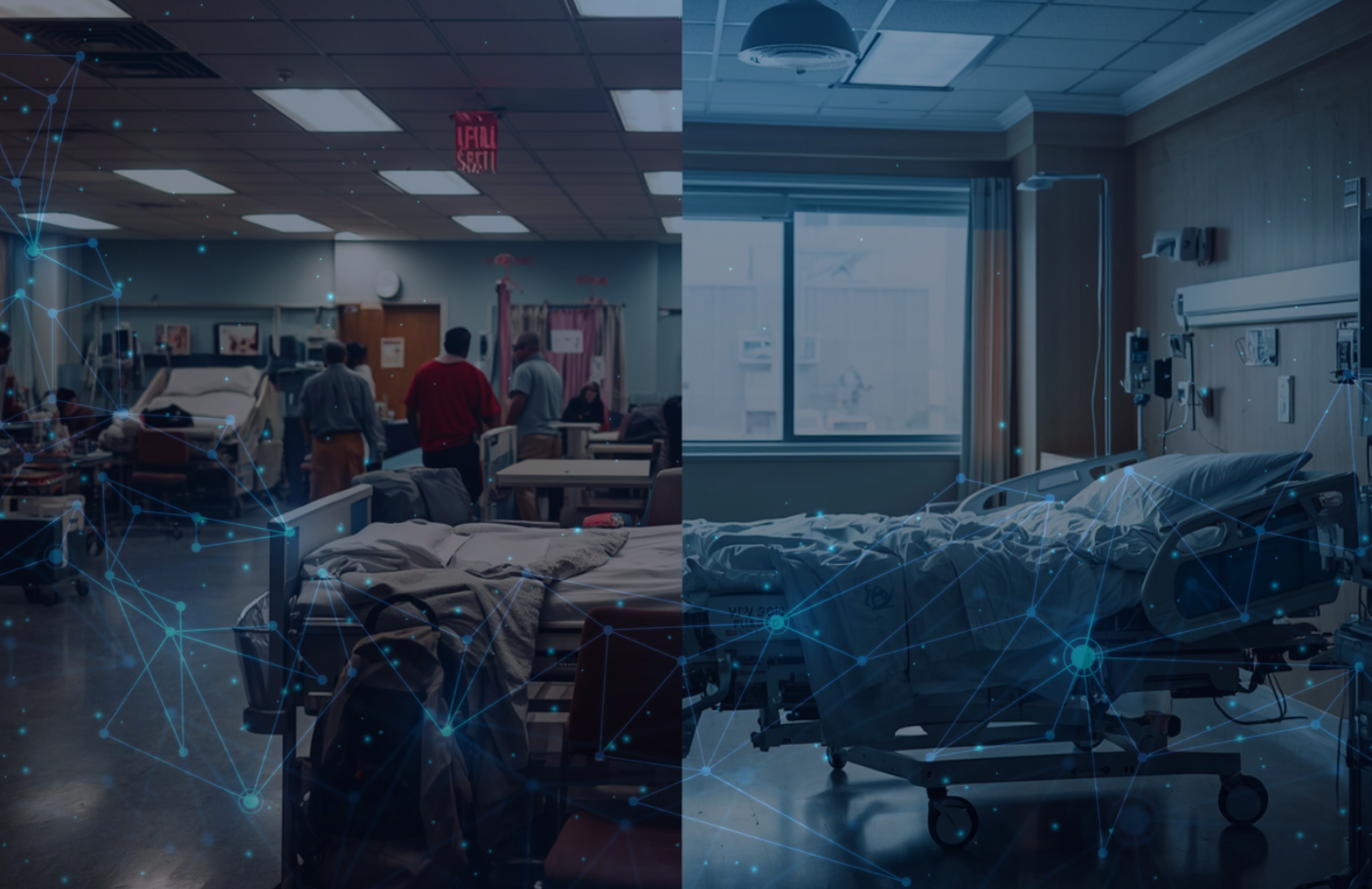
Meanwhile, in an emergency room just a few hundred meters away, a patient waits four hours not because there is a shortage of doctors, but because the triage process has never been redesigned.
An operating room closes at the end of the day with unused capacity, not due to a lack of surgeons, but due to scheduling errors .
A highly skilled specialist spends part of their time filling out forms that a well-designed process would eliminate.
Inefficiency isn’t visible in the equipment. It’s in the processes. And are the processes receiving the proper and necessary focus?
At Value Health Data, we develop tools that make these flows visible, from capacity dashboards and triage flow maps to predictive models for operating rooms (eg, occupancy, turnaround times). When the flow is visible, improvement becomes inevitable.
Why hospitals remain inefficient despite investment.
For decades, the response to any operational dysfunction has followed the same pattern: add resources: more beds, more consultations, more staff, more budget.
It’s a quantitative response to qualitative problems. And the results are consistent: waiting lists that grow regardless of investment. Costs on an upward trajectory without a proportional improvement in results. Exhausted professionals, not for lack of vocation, but because they operate in processes that generate unnecessary friction every day.
The response ‘more beds, more consultations, more budget’ ignores hospital process optimization, workflow management , and Lean — pillars that reduce waiting times and costs through design changes, not just by adding resources.
In other sectors, this level of structural inefficiency would be economically unsustainable. In healthcare, it has been progressively normalized. Even reinterpreted as an inevitable consequence of complexity.
Hospital operations management: why complexity demands well-designed processes and data.
The healthcare system is genuinely complex. High clinical variability, decisions made under uncertainty, multiple stakeholders, intense regulation. This is a reality.
But complexity doesn’t justify disorganization. On the contrary, complex systems demand explicit operational design, robust metrics, and continuous data-driven improvement. Complexity is an argument for investing more in operations management, not for abandoning it.
Operations management in healthcare remains undervalued. Lean (to eliminate waste) + technology and data (to measure and predict) is the combination that transforms complexity into performance.
There is a paradox that refuses to be ignored: we demand the highest rigor from healthcare professionals in clinical decisions, and yet we allow them to work with processes that no one has ever optimized, or when they are optimized, is it always done with the necessary expertise?
Is it right to demand surgical precision in a room where no one has ensured the basic operating conditions?
What is at stake and how do we begin to change?
In the coming days, I will explore this topic in more depth. I will discuss operational waste, technology applied well and poorly, automation, and processes that liberate instead of imprisonment.
Not to criticize those who work in the sector, quite the opposite: to bring to the table a conversation that is far too long overdue.
Because improving how healthcare works isn’t a technical problem.
It’s a choice.
And it means understanding that Lean and technology, when well combined, are not threats to clinical practice: they are what can free healthcare professionals to do what they were trained to do.
Ready to improve workflow and reduce waste in your hospital?
If you want to reduce waiting times, increase operating room efficiency, or digitize critical workflows, talk to us at Lean Health Portugal. And, when the challenge calls for advanced analytics, Value Health Data provides predictive models, optimization, and capacity visualization for faster and safer operational decisions.
Send us an email to lean@leanhealth.education
Frequently Asked Questions (FAQ)
How can I reduce hospital waiting times without hiring more resources?
Most wait times result from poorly designed processes. Through Lean Healthcare and applied data analytics (Value Health Data), it is possible to redesign workflows, eliminate waste, and improve capacity without increasing costs.
What does operations management in healthcare mean?
It is the discipline responsible for designing, measuring, and optimizing the processes that support clinical care — from triage, hospitalization, operating room, outpatient consultations to administrative circuits.
What is Lean?
It is a structured approach to continuous improvement that identifies and eliminates waste, improves workflows, and increases operational efficiency without sacrificing clinical quality.
How does Lean Health Portugal address these challenges?
Lean Health Portugal redesigns processes, maps workflows, optimizes resources, and implements continuous improvement routines directly with clinical and administrative teams.
What does Value Health Data do?
Value Health Data makes workflows visible through dashboards, predictive models, and decision support tools such as AoT and SoT, enabling faster, data-driven decisions.